
The National Association for the Advancement of Colored People is the nation’s oldest and largest civil rights organization. Our mission is to achieve equity, political rights, and social inclusion by advancing policies and practices that expand human and civil rights, eliminate discrimination and accelerate well-being, education, and economic security of Black people and all persons of color.
This being said, membership in the NAACP is open to all. We are a nonpartisan, inclusive organization that welcomes individuals of every background, identity, and political perspective.

The NAACP Princeton University College Chapter, or NAACP Princeton for short, builds on this legacy through programming and community engagement. We frequently host speakers across fields such as policy, economics, and healthcare to educate students and community members on topics that matter through activists, leaders, and professionals in those fields and form meaningful opportunities for connections. Additionally, we organize advocacy initiatives, educational workshops, and civic engagement efforts. We collaborate extensively with other campus organizations, prioritizing coalition-building and collective action in response to the evolving needs of underrepresented communities.
Knowledge is a tool. Community is power.
History and Legacy
Founded in 1909 in response to growing violence, disfrachisement, and systemic discrimination faced by Black Americans, the NAACP emerged as one of the most influential civil rights organizations in American History. It was established by a multiracial coalition of activists, scholars, journalists, and other leaders, to combat racial injustices.
Throughout the 20th century, the NAACP stood at the forefront of nearly every major civil rights struggle in the United States. Most notably, the organization helped dismantle legalized segregation through landmark legal victories such as Brown v. Board of Education. The NAACP also contributed significantly to the passage of the Civil Rights Act of 1964 and the Voting Rights Act of 1965.
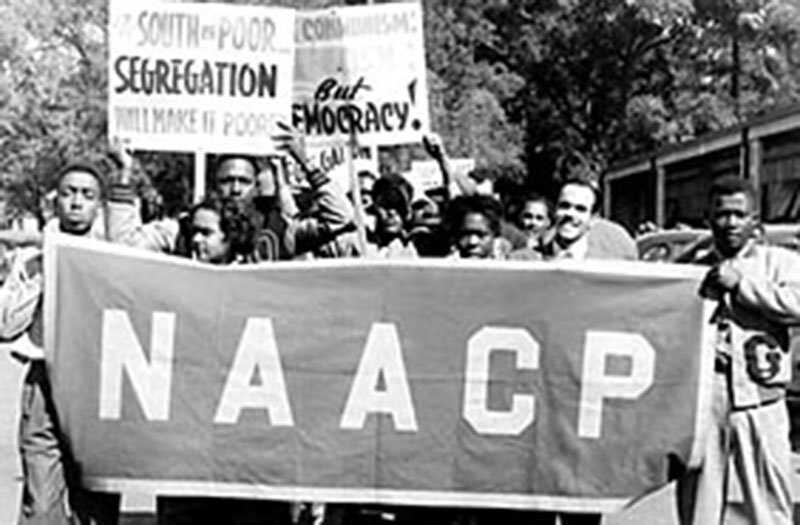
Beyond legal victories, the NAACP has mobilized communities to confront inequities in education, housing, healthcare, political representation and criminal justice. Its history includes organizing anti-lynching campaigns, expanding voter registration, supporting economic empowerment, and advocating for equal opportunity across every sector of American life.
Today, the NAACP continues this work by addressing longstanding and emerging challenges faced by marginalized communities. The NAACP remains committed to advancing equity, protecting civil rights, and empowering future generations of leaders. As part of this national legacy, the Princeton chapter connects students to a powerful network of activists, leaders, and professionals who continue to shape the future of this nation for minority communities.